
A business's social media usually fails under self-management for three reasons: every post asks for the sale, the pace drops when the owner gets busy and there is no local advertising behind it. Buffer measured that people who post in 20 of 26 weeks get more than 5 times the engagement per post of those who post in 4 weeks or fewer.
You open your business’s Instagram. The latest post is three weeks old: a product photo with the price and a “DM us”. It has four likes, two of them from your family. Before that, another one just like it. And before that, a trending video you recorded because “that’s what works”.
You are not short on effort. You have put in late nights, paid for templates and watched tutorials. What decides the result lies in three questions: what you post, how often and for whom.
This article starts from a video by Gary Vaynerchuk, What to Post When You Run a Small Business (9 minutes). We watched it in full, separated what it says from what it leaves out and checked it against studies by Buffer, Sprout Social and Instagram’s official announcements. At the end you have a criterion for deciding whether you keep doing it or delegate.
What does Gary Vaynerchuk say and what is missing?
The video combines a talk to real estate agents and an interview. His ideas, in order:
- Your content is selfish. Buy this house with me, come to my open house. Gary looked at the accounts of the people coming to his talk and almost every post was a property listing.
- Be the mayor of the town where you sell. Let people fall in love with you before they buy from you. If you like golf, post golf: people think “he likes golf, I like him, now I know him”.
- A personal brand is a moat. For him it is the only asset that does not become a commodity, not even with AI.
- The store is the studio. His show Wine Library TV had no microphone or lights, and it came from a single liquor store, his dad’s.
- Facebook ads in a 10-mile radius. For a business the customer visits in person, he considers it the biggest opportunity to bring in traffic and raise the average ticket.
- Quantity matters. In his view quality is subjective and quantity is not. Every post is a turn at bat.
What is missing? Two things. He talks about quantity without saying how much, or from what point it stops paying off, and he assumes the owner has free hours to film. Both can be measured, and the data is below.
Mistake 1: every post asks you for the sale
If your profile is a catalog, people who arrive have no reason to stay. Nobody follows a shop window.
Sprout Social asked 4,044 consumers in the United States, the United Kingdom, Canada and Australia who follow at least five brands. About half said original content is what makes their favorite brands stand out. They can find price and product anywhere; what they cannot find anywhere else is the way you work.
Try this with your last ten posts. Mark how many only say “buy”. If it is more than half, you know where to start. The others can tell how you choose your merchandise, what customers ask you and what you would answer, a mistake you saw this week or what happened behind the counter.
Mistake 2: you post when you remember
This is the owner’s mistake par excellence. You post three times in a good week, then month-end closing arrives, the fridge breaks or an employee is missing, and the account goes silent for a month.
In January 2025, Buffer analyzed more than 100,000 of its users over 26 weeks and grouped them by how many weeks they posted at least once:
| Group | Weeks with a post (out of 26) | Engagement per post |
|---|---|---|
| Inconsistent | 4 or fewer | Baseline |
| Consistent | 5 to 19 | 340 % more than the baseline |
| Very consistent | 20 or more | 450 % more than the baseline, more than 5 times |
It is a correlation among users of a single tool, and Buffer warns about that. But the pattern matches what Gary says: if you do not post, you do not get a turn at bat.
How much is enough? In another study, from August 2025, Buffer reviewed 2.1 million posts from 102,000 Instagram accounts. Compared with posting 1 or 2 times a week:
| Posts per week | Reach per post |
|---|---|
| 3 to 5 | about 12 % more |
| 6 to 9 | about 18 % more |
| 10 or more | about 24 % more |
The big jump comes from going from 1–2 to 3–5. Beyond that, each extra post adds less. For an owner who also runs the business, 3 posts a week, sustained, are worth more than 10 one week and zero the next.
Mistake 3: you wait to have the perfect studio
Many owners do not post because “I don’t have a good camera yet”, “the store is messy” or “I need lighting”. Gary sums it up this way: the best studio in the world is the world. To his clients, who according to him are mostly Fortune 500 companies, he proposes filming in stores, parking lots and festivals.
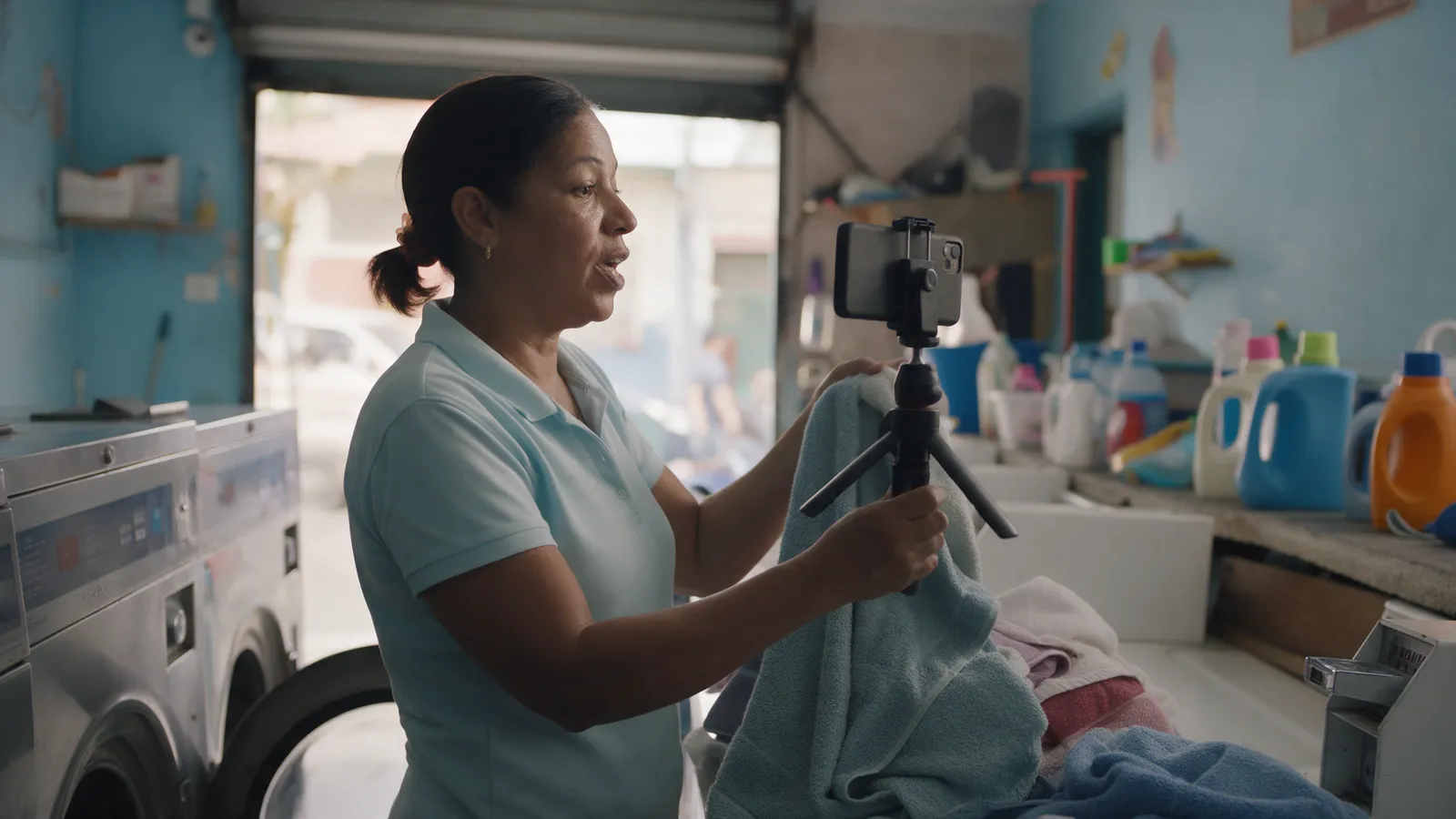
Your laundromat, your corner store or your practice is already the set. Showing where you work and how you do it proves you are real, something a pretty background cannot achieve. The only thing not worth skimping on is sound: if people cannot understand you, they leave.
Mistake 4: you repost other people’s content
Sharing another account’s meme or the viral video of the moment fills the profile, but Instagram stopped rewarding it. On April 30, 2024 it announced four changes:
- When it finds two identical pieces, it recommends only the original, as long as it is recent.
- Accounts that repost other people’s content 10 times or more in 30 days are removed from recommendations.
- Reposts carry a label with a link to the original creator.
- Each eligible post is first shown to a small audience, whether or not they follow the account, and grows if that audience responds.
That last one is good news for a small business. An account with 300 followers can reach strangers if what it posts is its own and interests someone. If you edit something by someone else and transform it, like a new meme or your own voice on top, Instagram does not replace it.
Mistake 5: you think organic is enough
Here Gary is blunt. If people come to your store, the biggest growth lies in Facebook ads within 10 miles around it. And self-management usually stops at posting, without paying for a single ad.
In the Dominican Republic the audience for those ads exists. DataReportal estimates that at the end of 2025 Facebook ads could reach 6.10 million people in the country and Instagram ads 5.10 million. These are advertising reach figures and do not equal active users, but they give the scale.
Adjust the radius to what your customer is really willing to travel: in Santo Domingo traffic, 16 km (10 miles) may be too much for a laundromat and too little for a specialized clinic. Organic content prepares trust; the ad puts it in front of people who live nearby.
Mistake 6: you chase every trend
Dancing to the trending audio looks like the quick way to grow. For a brand, the audience sees it differently. In the same Sprout Social study, about a third of consumers said brands jumping on viral trends is embarrassing, and 27 % think it only works within the 24 to 48 hours a trend lasts.
In other words, if you take three days to film it, you are late. Use a trend only when it fits what you sell and you can do it the same day. Otherwise, your time pays off more on Mistake 1.
Mistake 7: you do not respond
Posting is half of it. The other half is comments and messages, and it is the half that drops most when the owner is busy. According to Sprout Social, 73 % of consumers say they will buy from a competitor if a brand does not respond to them on social media.
If most of your messages end up on WhatsApp, organize that step too: in how to sell more with WhatsApp Business we explain how to reply within the 24-hour window and follow up.
Do you keep doing it or delegate?
Self-management works for many businesses. The problem starts when the owner keeps it up at the expense of everything else. This is the criterion we use to decide:
| Sign | You can keep doing it | Better to delegate |
|---|---|---|
| Consistency over the last 3 months | You posted at least once every week | There were weeks or months without posts |
| Replying to messages | The same day | The next day or never |
| Ads | You already pay for local ads and know what a message costs you | You have never paid for one or you use “Boost” without measuring |
| Measurement | You know which post brought you customers | You do not know where your customers come from |
| Your time | Social media does not take hours away from selling or operating | You film at dawn or stop serving customers to post |
If you checked two or more in the right column, it is worth at least getting a quote from someone to do it. Even when delegating, you stay in front of the camera: Gary insists the owner is the brand. What you delegate is the plan, the editing, the calendar, the ads and the measurement.
What to fix this week
- Count your last 10 posts. If more than half only sell, next week post two that teach or tell something about the business.
- Choose a pace you can sustain, even if it is 3 a week, and put it in your calendar like an appointment.
- Film in your store, with your phone and good sound.
- Check your profile: if someone arrives from an ad, they must understand within seconds what you do. You have the step by step in how to optimize your Instagram bio.
- Set aside a small budget for local ads and measure how many messages each dollar brings.
For the full plan of unpaid content, with a 30-day calendar, there is the guide to organic marketing for your business. And if you are going to post often, keep the image sizes for social media at hand.
We tell you this as business owners: the most expensive mistake is to keep posting the same way for another six months expecting a different result. If you want us to review your account and tell you what to fix first, message us on WhatsApp.
Sources
Accessed on October 26, 2026.
- Gary Vaynerchuk, What to Post When You Run a Small Business, YouTube, 9:24. Watched in full with its original English subtitles.
- Buffer, consistent posting study, January 29, 2025: more than 100,000 users, 26 weeks.
- Buffer, how often to post on Instagram, August 13, 2025: 2.1 million posts from 102,000 accounts.
- Sprout Social, Sprout Social Index 2025 press release, January 7, 2025: Glimpse survey of 4,044 consumers in the United States, the United Kingdom, Canada and Australia, September 13 to 27, 2024.
- Instagram, recommendations and original content, April 30, 2024.
- DataReportal, Digital 2026: The Dominican Republic: Facebook and Instagram advertising reach at the end of 2025.
Frequently asked questions
How many times a week should a business post on Instagram?
Buffer analyzed 2.1 million posts from 102,000 accounts and placed the sweet spot at 3 to 5 posts per week. Posting more still adds reach, but each extra post yields less.
Do I need professional equipment to film content for my business?
Not to start. Gary Vaynerchuk built his brand with Wine Library TV without a microphone or lights, filming inside his family's store. What you do need is good sound and something to show.
Is it worth sharing other accounts' content on my profile?
Less and less. Since April 2024 Instagram recommends only the original when it finds identical content, and removes from its recommendations accounts that repost 10 times or more in 30 days.
Is organic social media enough for a local business?
Rarely. Gary Vaynerchuk says the biggest opportunity for a business people visit in person is Facebook ads in a 10-mile radius around the store. Organic content builds trust; the ad puts that trust in front of the neighbors.
When does it make sense to delegate social media?
When you have gone three months without keeping up at least one post a week, when you do not answer messages the same day or when you do not know which post brought in a customer. With two of those signs, it is worth at least getting a quote from someone to do it.